




Researchers to develop new generation of technology for art conservation 

 28 Sep 2010 


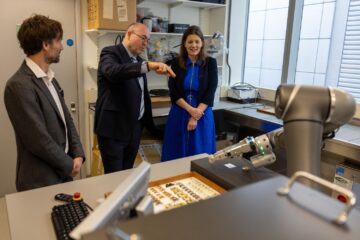
Modern OCT technology is being used to examine valuable works of art

Researchers developing state-of-the-art technology to help with the conservation of priceless works of art have received over £600,000 of funding from the Science and Heritage Programme of the Arts and Humanities Research Council (AHRC), and the Engineering and Physical Sciences Research Council (EPSRC) to help with their research.

The team at Nottingham Trent University will use the money to develop a new generation of technology, which it is hoped will become a tool for use by galleries and art conservators around the world.

Since 2004, Dr Haida Liang from the University's School of Science and Technology has led groundbreaking research into the application of Optical Coherence Tomography (OCT) for the non-invasive examination of paintings.

Originally developed as a medical imaging tool, OCT uses infrared light to penetrate biological tissue which scatters the light back. This scattered light is then detected by the device, allowing it to measure the distance it has travelled and therefore produce a three-dimensional image of the inner structures of the tissue.

However, since realising the potential for OCT to be applied in the examination of works of art, Dr Liang and her team have spent the past six years pioneering various applications for work in art history, archaeology and art conservation.

In the case of paintings, the depth and distribution of paint and varnish layers, and even artist's preparatory drawings can be made visible, all of which can help art conservators and curators to better understand the historical significance and what is required to preserve priceless artefacts.

Dr Liang and her team now hope that a variety of improvements can be made to the effectiveness of current OCT systems, all of which will be of enormous benefit to its users.

Using the grant from the AHRC and EPSRC, they will now turn their attention to developing an OCT system which uses a broader band and longer wavelength of light to improve the resolution and depth of penetration that can be achieved.

These improvements will allow OCT users to collect a level of detailed information which is currently only possible by physically removing samples from artefacts and examining them with a microscope. It will also help to establish a reputation for OCT as a tool for non-invasive imaging in the heritage field, highlighting the benefits it has as an early warning tool for detecting deterioration and problems for conservation.

In addition, an ongoing partnership with the National Gallery and a recently formed collaboration with English Heritage will allow the researchers to apply OCT to the examination of paintings, enamels, glass, ceramics etc.

Dr Liang said: "I'm very excited about where we can take our research with this funding, and I'm confident that we'll continue to develop and refine the technology in a way that will see it making an even greater contribution to the world of art conservation and archaeology."

END

Notes to editors:

In carrying out this research, Nottingham Trent University is the lead partner and will manage the funds, whilst portions of the total funding will be distributed to the National Gallery and the University of Southampton who are contributing their own areas of expertise and resource to the project.

Co-investigators and partners for the research project are:

Professor Andy Clarkson – University of Southampton
Marika Spring – Scientific Department, National Gallery
English Heritage
Gooch and Housego PLC.

Media Contact: Jake Gilmore, AHRC Communications Manager; T: 0797 099 4586,
E: j.gilmore@ahrc.ac.uk

UK Science & Heritage Research Programme: The Arts and Humanities Research Council and the Engineering and Physical Sciences Research Council are managing this research programme that runs initially, for five years. The programme is led by Programme Director, Professor May Cassar of UCL. Professor Cassar leads on the programmes development, external coordination and outreach as well as on extensive networking with the national and international research community including non-academic sectors. In addition she is also establishing the base line level of funding across all the research councils and developing a comprehensive map of recent and current research and training activity in heritage science.

Arts & Humanities Research Council (AHRC): Each year the AHRC provides approximately £112 million from the Government to support research and postgraduate study in the arts and humanities, from languages and law, archaeology and English literature to design and creative and performing arts. In any one year, the AHRC makes approximately 700 research awards and around 1,350 postgraduate awards. Awards are made after a rigorous peer review process, to ensure that only applications of the highest quality are funded. The quality and range of research supported by this investment of public funds not only provides social and cultural benefits but also contributes to the economic success of the UK.